By
Amber Rasche - Communications Manager, Internet2
Estimated reading time: 7 minutes
Each year, hundreds of volunteers from research and education (R&E), government, and industry come together to build SCinet, the high-performance network that connects the SC Conference to the world. For SC26, Nov. 15-20 in Chicago, SCinet’s wide area network is planned to deliver 19.6 Tbps of capacity, with contributions from more than 50 organizations, including Internet2.
The SC26 conference theme, “HPC Unites,” describes SCinet well. No single organization builds it. The network is a collaborative effort that serves as a foundation for collective technological and scientific progress.
SCinet also brings people together. Seasoned network engineers, security analysts, developers, and other IT professionals volunteer alongside early-career colleagues. They share expertise and build professional connections. That experience continues to provide value long after the event ends and the temporary network is torn down. For the R&E community, that hands-on knowledge transfer helps build a pipeline of IT talent as institutions navigate workforce transitions.
Internet2’s Network, Trust, and Cloud Expertise at SC26
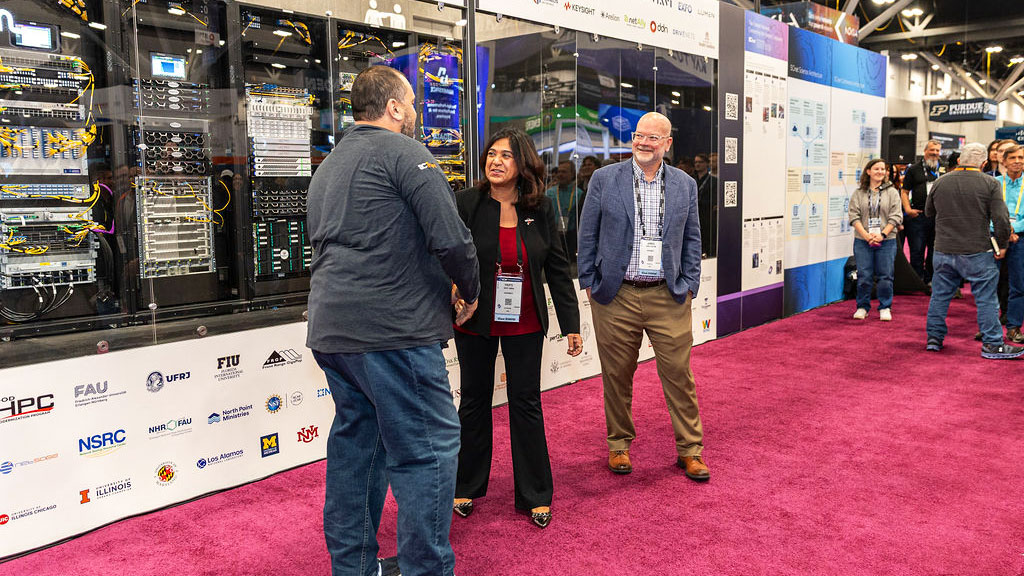 Internet2 executive leaders Tripti Sinha and James Deaton at the SC25 SCinet Awards Ceremony
(Photo credit: Lillie Elliot, SC Photography)
Contributing to SCinet is an extension of Internet2’s role in providing the national network, trust fabric, and cloud access that power U.S. R&E. We are proud to bring expertise and services as a Diamond-level SCinet Contributor this year.
Internet2 staff who volunteer for SCinet learn from this significant training opportunity, too. They work side by side with peers from other R&E networks and industry, gaining hands-on experience with technologies they haven’t encountered before. Ultimately, they bring that knowledge back to the shared infrastructure and solutions that support Internet2 members and the broader R&E community.
Take a closer look at our part in this collaborative effort, including support for three network research demonstrations where SCinet’s advanced capabilities enable science at SC26.
Internet2’s Contributions to SCinet for SC26: By the Numbers

- 7.6 Tbps of SCinet’s 19.6 Tbps wide area capacity contributed by Internet2
- 1.6 Tbps of conference connectivity, linking attendees to Internet2-connected institutions and to cloud and commercial peers through Internet2 R&E, Internet2 Peer Exchange, and 800 Gbps capacity from Internet2’s Chicago core site to the SCinet Network Operations Center.
- 6 Tbps across six high-capacity paths from Seattle, McLean, Kansas City, and Chicago, supporting research demonstrations with StarLight, Ciena, and the National Research Platform
- 1 landing point in Internet2’s Chicago core site for connections from Caltech, Japan’s National Institute of Informatics, and Florida International University’s AmLight
- 17 SCinet NRE demonstrations supported, including 1 co-led by Internet2
- 2 dark-fiber projects for quantum key distribution and precision timing
- 1 eduroam Wi-Fi dashboard returning to provide data visibility for U.S. institutions
- 15 Internet2 staff volunteering across 10+ SCinet and SC teams
Learn more about connecting with Internet2 at SC26.
A Test Bed for Network Research and Scientific Discovery
Each year, the SCinet Network Research Exhibition (NRE) leverages the network as a test bed for cutting-edge demonstrations and experiments. NRE is where researchers and technologists test new ideas for high-performance networking, computing, storage, and analysis to enable data-intensive science.
Here are three of the 17 NRE demonstrations Internet2 is supporting at SC26, alongside other contributors and R&E community members. We also donated 100 Gbps connections to the Great Plains Network at booth #5050 and to Clemson University for the South Carolina Research Computing Consortium’s booth #641, so these Internet2 member organizations can run their own demos from the SC26 exhibit floor.
Quantum Key Distribution on Chicago Metro Fiber
As quantum technologies advance, the R&E community needs quantum-safe encryption methods to protect its data. Internet2, as part of its quantum readiness effort following a successful post-quantum cryptography demonstration, is in the early stages of developing operational experience with quantum key distribution (QKD) on its national network and other R&E fiber. SCinet NRE 134 runs a live QKD link on Chicago metro fiber between Internet2’s Chicago core site and the SC26 convention center. Tampering with the quantum strand during the demonstration will show the error rate rise and key delivery fail in real time, proving that a tap on the fiber is detectable.
- Who Is Involved
- Internet2, IonQ, and Quantum Foundry are co-leading this NRE demonstration.
- Why It Matters
- R&E institutions hold sensitive, regulated research data that must stay protected for years. That includes protections against “harvest now, decrypt later” threats, where data captured today could be decrypted by future quantum computers. Early test bed work gives Internet2 hands-on experience with quantum-safe technologies now, to prepare for what’s ahead.
- How Internet2 Helps Enable It
- As a co-lead of this demonstration, Internet2 is providing the optical transport, core site, and the secure management network. It is also coordinating the dark fiber and handling the staging and installation of the demonstration equipment.
Seeing the Science in the Traffic: Large Hadron Collider Packet Marking
When the High-Luminosity Large Hadron Collider (HiLumi LHC) comes online in 2030, the data that physicists worldwide depend on will grow by an order of magnitude. With that growth, network operators will need to identify which flow belongs to which experiment or workflow stage. The solution is scientific network tags, or scitags, a packet-marking approach that labels data at the source to indicate which science it serves. SCinet NRE 125 is demonstrating the marking on real production workflows from the University of Victoria, an ATLAS computing site, to the StarLight booth at SC26. (The related NRE 124 puts scitags to work on a transpacific link.)
- Why It Matters
- When networks can see which science each dataflow supports, operators can better manage traffic around research priorities. That helps global scientific collaborations and the institutions that support them keep pace with data growth.
- How Internet2 Helps Enable It
- Internet2 is providing 2.8 Tbps of network capacity from Seattle directly to the StarLight booth on the SC26 exhibit floor. That includes two 800 Gbps connections on Internet2 spectrum and optical equipment, plus three 400 Gbps NA-REX circuits carried on Internet2’s network. With its collaborators, Internet2 is also providing three 400 Gbps of transatlantic connectivity that lands at its Manhattan Landing (MAN LAN) global exchange point and continues across the national backbone to Chicago, augmenting the 400 Gbps carried by MOXY via NA-REX to Chicago.
Live AI and HPC Workflows Across a National Cyberinfrastructure
The National Research Platform (NRP) is the shared Kubernetes cluster that thousands of researchers and students across the country use for artificial intelligence and high-performance computing work. SCinet NRE 108 is adding an NRP node inside SCinet and running live workflows across multiple network domains. The workflows include LHC data processing and the AutoGOLE/SENSE automated network orchestration that ties in national efforts like the Genesis Mission and American Science Cloud. (The related NRE 106, 107, 112, and 122 also leverage the Chicago metro connectivity to the SCinet NRP node.)
- Who Is Involved
- The San Diego Supercomputer Center and the National Research Platform are leading this NRE demonstration with participation from ESnet (SENSE), StarLight, FABRIC, Caltech, Chameleon Cloud, the Open Science Grid, and Internet2.
- Why It Matters
- For R&E institutions, this shows what researchers can already do with access to shared cyberinfrastructure and where campus research is headed. National resources for AI and data-intensive science, like the NRP, help close the gap when local capacity runs short.
- How Internet2 Helps Enable It
- Internet2 is providing 400 Gbps of network capacity from its Chicago core site into SCinet, port-mapped directly to the SENSE switch next to the NRP node. That direct connection lets the experiment control its own end-to-end bandwidth.
Connect with Internet2, See SCinet in Action
Heading to Chicago for SC26? Visit Internet2 at booth #3829 to connect with the team. Then, stop by the neighboring SCinet Network Operations Center at booth #3034 to see the network in action.
Video courtesy of the SC Conference Series
ICYMI
About the Author(s)
Amber Rasche supports strategic communications and media relations in service of Internet2’s mission to advance the research and education community. She has 14+ years of experience in higher education IT and in research, education, and government high-performance networking environments. From technical writing to storytelling, she enjoys shining a light on collaboration and innovation—and the people who make it all possible.