Estimated reading time: 8 minutes
It’s hard to imagine now, but more than a decade ago, the research and higher education (R&E) community was only beginning to have collective discussions about the cloud. Tom Dugas, winner of the Internet2 NET+ 2026 Cloud Superhero Award, played an integral role in getting those conversations started. Tom currently serves as Duquesne University’s vice president for technology and CIO and is co-founder of the Cloud Computing Constituency Group.
A colleague approached him about co-leading the effort and he agreed, despite his own unfamiliarity with the cloud. “At that point in my career (at Carnegie Mellon University), I was working in endpoint computing, and I didn’t really do a lot with the cloud and didn’t know much about it,” he recalled. “So, there I was, kicking off the first-ever cloud constituent group for EDUCAUSE and building a community of practice around it for the first time in higher education.”
Similar conversations had started at Internet2, where Tom was a member of Cloud Services Working Group, which merged with the EDUCAUSE group in 2011. “We decided to merge the two to create this new cohesive group,” he explained. “My colleague Steve Terry, who was the CIO at Denison University at that time, partnered with me on that activity.” Known today as a community group, its participation has grown from about a dozen leaders to more than 2,000 cloud practitioners.
So begins one IT professional’s journey on the road to leadership in the R&E cloud community. Tom’s motivation for helping break new ground? “It was a great opportunity to give back,” he said. To paraphrase Robert Frost, two roads diverged; Tom took the one less traveled. And that has made all the difference.
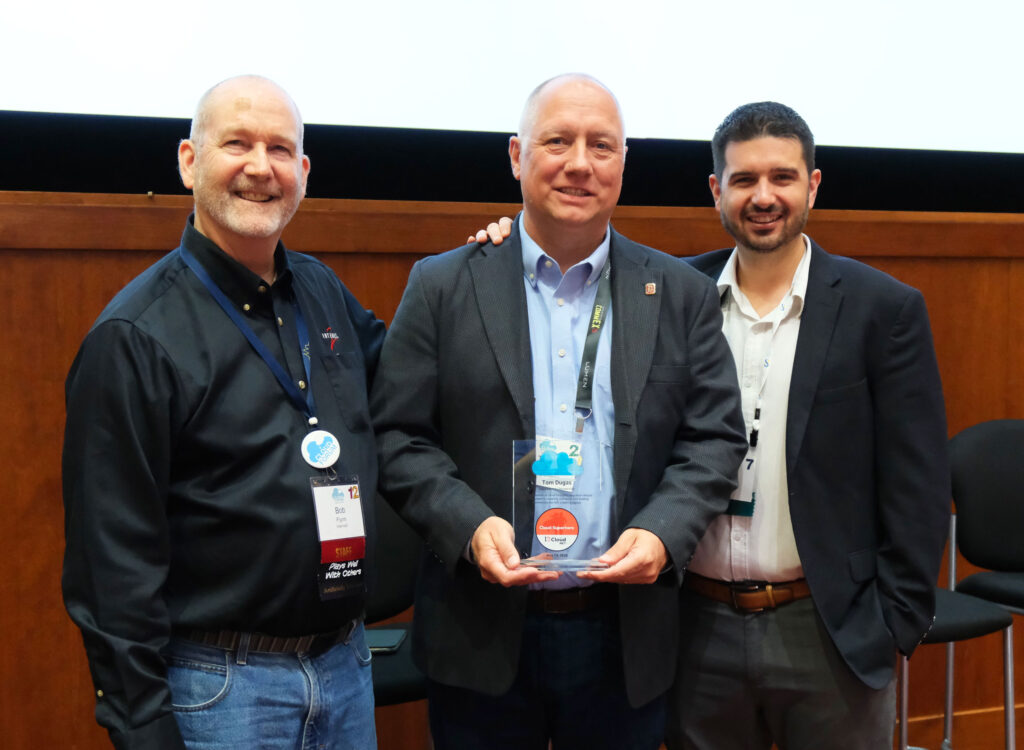 Internet2’s Bob Flynn (left) and Sean O’Brien (right) congratulate Tom on winning the Cloud Superhero Award.
Making the Difference
Once engaged with the R&E cloud community, Tom continued to contribute in numerous ways. One notable contribution was his coordination and co-authorship of a series of papers, “Preparing the IT Organization for the Cloud.” The papers were commissioned by the EDUCAUSE Center for Analysis and Research (ECAR) Cloud Working Group.
“The group asked me to help write a cloud paper,” Tom recalled. “Mike Chappell, one of the most renowned authors in cybersecurity, co-led this effort with me. When Mike and I started to talk about it, we quickly realized that we couldn’t write just one paper.”
Led by Tom and Mike, the group of 20+ colleagues wrote seven papers, which were published and distributed to the community, firmly establishing Tom as an early leader in cloud computing in higher education and paving the way for future developments.
In addition to being a prolific writer, Tom has shared his time and expertise through his participation in Internet2 NET+ advisory groups. He currently serves on the NET+ Program Advisory Group. Previously, he was a member of the Cloud Scorecard Advisory Group, which helped design the Internet2 Cloud Scorecard.
Tom attributes much of his personal and professional development to his active involvement in the community. “Internet2 connected me with some of the brightest and smartest people in the world, who were leaders and pioneers in this space for cloud computing,” he said.
“I would not be the leader or the person I am today without everything I’ve learned from all of the tremendous people I worked with over the years,” he continued. “The wealth of information, experience, and talent that I’ve gotten to engage with is just amazing.”
Coming to Agreement
From Tom’s perspective, the progress the community has made together is equally “amazing, what we’ve been able to accomplish, in what I believe is a short period of time, and look at what we’re able to do now.”
“I was there with the team at Internet2 negotiating the early contracts with Google and other cloud service providers,” he recalled. “We were trying to get the best deal for higher education, and I still feel like that’s my job every day: to get the best deal and services for higher education with any provider, including cloud services providers.”
Tom credits NET+ with leading the charge to negotiate the best terms, pricing, and partnerships with cloud service providers. “I am an advocate for using NET+ agreements, and will continue to be because, truthfully, organizations like Duquesne cannot succeed without programs like NET+,” he said. “We’re able to take advantage of pricing opportunities with these agreements that would otherwise be unattainable for an organization like Duquesne.”
As such, Tom spoke highly of the NET+ Service Evaluation Process and the importance of the community’s involvement. “There are very few things I negotiate in a NET+ agreement on top of what’s already there, so I get the benefit of all those terms and conditions that I helped contribute during the last 20 years by being active in the community,” he said.
“I feel personally responsible to help build our community of practice, and I feel a sense of pride in the work that we’ve all contributed to make it successful,” Tom continued. “Also, I get to harness all the contributions from everyone else together to make my institution better.”
“We have, in my opinion, changed what cloud computing can be, will be, and will want to be in the future,” he added. “Because of our time and investment, we have a collective voice as a community to help service providers understand how important higher education is to them.”
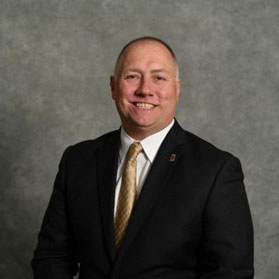
More Insights from Tom
The best part about being CIO: It’s amazing how many people we get to engage with and talk to about the technology needs they have on campus. We hear about problems they’re trying to solve and challenges they have with the institution’s technology. I get to see all that now and be a part of solving those problems by finding technology to augment and support those activities. It’s exciting to be a part of that. In my previous role as the university’s chief information security officer, I helped people protect all the information and systems across campus. In this new role, I get to protect them, but also maximize the potential benefit of all that technology as well.
The greatest challenge facing R&E in implementing cloud services: One of the aspects that has always been hard about cloud computing in higher education is just how vast it is in scope across the spectrum of services. How far do you want to go in cloud computing? Because you can do almost anything you want in the cloud. The question is, what are you trying to accomplish? Cloud computing touches everything and anything in IT these days, so our challenge is staying focused on what we need to do to make sure cloud computing is attainable and has the best opportunity for success in our organizations.
The importance of having an active and vibrant cloud community in R&E: Being active in the community has allowed me to work on projects and gain knowledge that I can bring back into my personal and professional opportunities at my own organization to help us get better. It has helped me discover how to do things differently as well as teach others what I’ve learned. It wasn’t always about just me gathering information. I have been able to help teach a lot of people how to do things differently and learn from what we did at our institution.
There’s more to come from Tom and the future leaders he hopes to inspire. “I started in higher education in 2006. When I jumped into the community in 2010, it was really my first introduction to volunteering, and I’ve been going strong ever since,” he said. In recognition of his extensive participation and leadership in the higher education technology community, Tom received the 2023 EDUCAUSE Community Leadership Award.
During this year’s Higher Education Cloud Forum at the University of Wisconsin-Madison, he added the Cloud Superhero Award to his many accolades. “I didn’t do any of this by myself,” Tom said of receiving the award. “The community has really been strong, and I’ve worked alongside a lot of people over the years, so this award is a recognition, not just for the things I’ve done, but for all the efforts to which they’ve contributed.”
“One of my proudest accomplishments in higher education is getting to see the fruits of my labor from starting this cloud community group with EDUCAUSE and Internet2,” he continued. “Without the contributions we put forward, we wouldn’t have had as many people come into the fold with cloud computing to really embrace it and grow with it.”
Seeing the group grow and go beyond his original vision has been especially gratifying for Tom. “When I go to conference sessions now, I see a new group of leaders who have emerged and taken the helm of that group to move it forward, taking it in areas I never imagined they could to make cloud computing better for higher education,” he said.
In the spirit of making things better for the next group of community leaders, Tom acknowledged that he joins a prestigious group of past Cloud Superhero Award winners, including Erik Lundberg and his mentor Jack Seuss. “I’m glad to follow suit with them and others who have received the award,” he said. “It’s really good to follow in the footsteps of such talented people, and I hope to set that same path forward for the next leaders who will receive this award.”
About the Cloud Superhero Award
Internet2 NET+ launched the Cloud Superhero Award in 2022 to recognize community members who possess cloud superpowers and share them with the research and education community. Previous recipients include Erik Lundberg (2022), Sarah Christen (2024), and Jack Seuss (2025).