By
Karl Newell - Lead Network Software Architect, Network Services
Estimated reading time: 6 minutes
New AIOps Program Gives Research and Education Network Engineers and Operators Tools to Troubleshoot Faster
Internet2 operates the national research and education (R&E) backbone that connects campuses to each other and to the world. Like engineers on every operations team, ours ask the same questions when a network alarm fires or a ticket comes in. What broke? Where? Which system holds the answer? Who is affected? Why did it break?
Answering those questions is often the most time-consuming part of troubleshooting. The faster an engineer has the full picture, the sooner they can do what they do best: solve the problem.
Getting our engineers to that picture faster is a big part of why we are building AI-capable tools in Network Services. The work also advances an objective of the community’s Trusted Infrastructure Program.
Earlier this year, we took the next step by forming a dedicated AIOps, or artificial intelligence for IT operations, program focused on three areas:
- Intelligent troubleshooting: AI-assisted analysis that cuts time to resolution for complex network issues
- Proactive operations: Automated triage that shifts operations from reactive to predictive
- Community scale: Extending AI-powered capabilities to campuses and regional R&E networks
I am excited to share the team’s progress, our long-term vision, and how the R&E community can get involved. If you want to go deeper, we are offering a hands-on tutorial, technical talk, and Network Software Lab booth at the 2026 Internet2 Technology Exchange, Oct. 26-30 in Minneapolis.
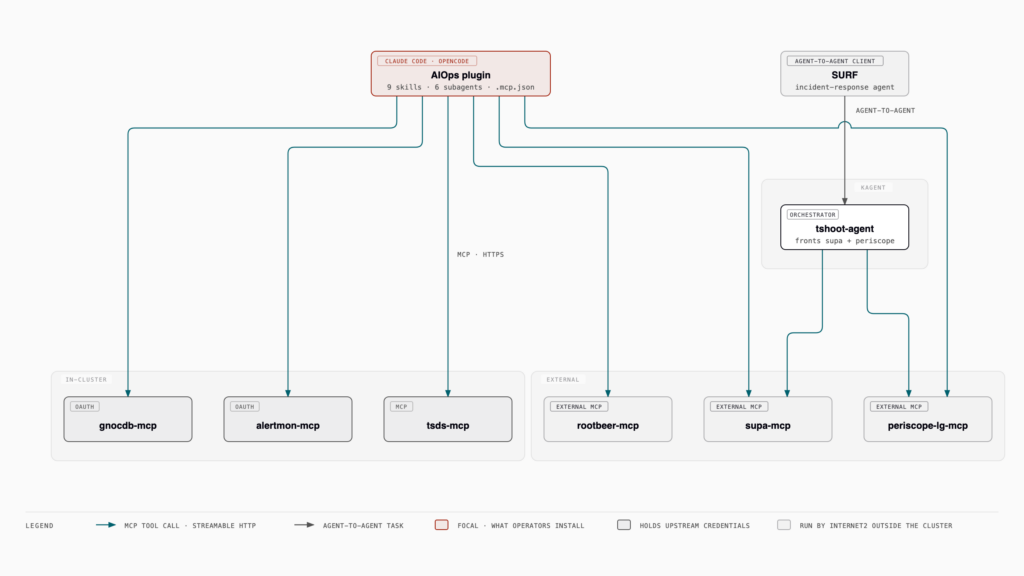 The Internet2 AIOps platform, HAWAT, uses MCP tools to query the configuration database, alert aggregator, time-series telemetry, NSF-funded ROOTBEER project, Network Service Interface circuit provisioning, and Internet2 Periscope.
Why Network Troubleshooting Takes Time
Network engineers are good at solving problems. What slows them down is everything that comes before the solution: hunting across a looking glass, a configuration database, telemetry, and a ticketing system just to understand what is actually going on. That context-gathering is repetitive; it is spread across a dozen tools, and it does not use any of the judgment we actually hire engineers for.
AIOps assembles that context automatically, so an engineer can skip straight to the fix. Our guiding principle is to augment human expertise, not replace it. A human is in the loop throughout, and the engineer still makes the final call. We are deploying these tools into the workflows our operators already use rather than asking them to learn something new. The goal is to reduce the mean time to investigate and mean time to repair.
This matters beyond Internet2 because R&E network troubleshooting routinely crosses organizational boundaries. A path that looks fine from one network can be broken two networks or a continent away. Tooling that is shared and, where it makes sense, federated across the R&E community gives every institution more diagnostic reach.
AI-Assisted Network Troubleshooting Available Today
HAWAT, or Heuristic Analysis With Adaptive Troubleshooting, is a multi-agent system for AI-assisted troubleshooting now live against the Internet2 production network and available for testing by our engineers. The design includes a set of purpose-built agents, each backed by a server that exposes one real operational system through the Model Context Protocol (MCP), so any capable AI model can use it. Today, those servers cover our distributed looking glass, the configuration database, time-series telemetry, and Network Service Interface circuit provisioning. Tools are read-only by default, which keeps the early deployment safe while we build trust.
One of those servers is now open to the community, too. In August, Internet2 released a public MCP server for the Looking Glass in Periscope, the successor to Insight Console. IT teams across the community can point their AI agents of choice at it and ask questions about the Internet2 network in plain language. It is the first of these MCP servers Network Services has made public, and we expect more to follow.
Agent-to-Agent Interoperability for Multi-Domain Troubleshooting
We have also proven the cross-organization case. In a proof of concept with SURF, the Netherlands national research and education network, our troubleshooting agent exposes capabilities like interface status, interface statistics, and circuit status as named skills that another organization’s agent can call across the boundary, without exposing the rest of our stack.
In June, we demonstrated that agent-to-agent flow at TNC26. We stood up a circuit across the Atlantic, and SURF asked their agentic system about it. When their system needed information about the Internet2 network, it automatically interfaced with our agent to get it.
Ironically, we spent time trying to optimize the demonstration because the agent-to-agent exchange took about five minutes, and that felt too long to us. But think about peers across time zones and continents troubleshooting a circuit. That kind of problem can take days. Five minutes is fantastic.
Ticket Triage and Machine Learning Up Next
The near-term roadmap is a troubleshooting assistant that graduates from an early version into full production use in network engineering, with the MCP server suite hardened and deployed behind it. From there, we are working toward automated ticket intake and triage, broader model evaluation so we choose the right model for each task rather than adopting by habit, and the authentication and observability work that a production platform requires.
Looking further out, the plans include machine learning for event analysis, such as anomaly detection and routing analysis. Our colleagues at SURF are already doing work in this area, and we will build on what they have learned.
Building an Open AIOps Framework for R&E Networks
The long-term goal is simple to state and hard to build: make context-gathering something engineers no longer have to do by hand, and make the HAWAT AIOps platform something any institution in the R&E community can run.
The intent is to open-source the platform and offer a packaged, containerized distribution so a member institution can deploy it on its own infrastructure. (The HAWAT GitLab repository is already available here.) The pieces are designed to compound. The multi-agent framework, the MCP servers that expose network tooling to any model, and the cross-organizational interoperability all reinforce each other. Every institution that adopts the platform adds diagnostic reach for everyone else. Expanding the agent-to-agent work to more national networks extends that reach across the global R&E ecosystem.
As adoption grows and the platform works as designed, the day-to-day changes in a concrete way. An engineer opens an incident, and the context is already assembled. Troubleshooting that crosses network boundaries becomes a collaboration between agents rather than a chain of phone calls and emails. The engineer spends their time on the decision and the fix, which is the part only a person can do.
Collaboration and How to Get Involved
HAWAT is being built in the open and in concert with others. The proof of concept with SURF is our first international collaboration in this space, and it points to a broader model for how national R&E networks can troubleshoot together. We build on the systems our collaborators already operate, and we coordinate with others in the community who are starting their own AI operations efforts.
We also build with our network engineers, not for them. We know from our earlier automation efforts that continuous feedback from the people doing the work is what drives success.
There are two ways for community members to get involved right now. First, connect your AI agent to the Looking Glass MCP server and start asking questions about the Internet2 network. Then, come find us at TechEX26. See the tools and tell us where they fall short. The feedback we get in those rooms drives what we build next.
Learn More at TechEX26
Stop by the Network Software Lab booth throughout the week to connect with the Network Services team, share feedback, and ask questions. Plus, check out these other sessions:
Hands-On AI-Powered Network Troubleshooting with LibreChat and MCP (tutorial, separate registration required) | Monday, Oct. 26, 1 p.m. CT
What’s Happening in Network Services | Tuesday, Oct. 27, 8:30 a.m. CT
HAWAT: Building an AI-Augmented NOC with Federated Agent-to-Agent Interoperability | Tuesday, Oct. 27, 11:20 a.m. CT
Peer-to-Peer Advanced Networking Unconference | Thursday, Oct. 29, 12:10 p.m. CT
ICYMI
About the Author(s)
Karl Newell is a Network Software Architect at Internet2, the US national Research and Education network, where he leads network automation and orchestration efforts. He is currently driving Internet2's AIOps initiative — an AI-augmented network operations platform built on open-source tooling and designed to expand operational self-sufficiency across Internet2 and its member community. His current work includes an Agent-to-Agent interoperability proof-of-concept with SURF using the Google A2A protocol. Karl has been instrumental in helping the broader R&E networking community explore and adopt network automation practices.